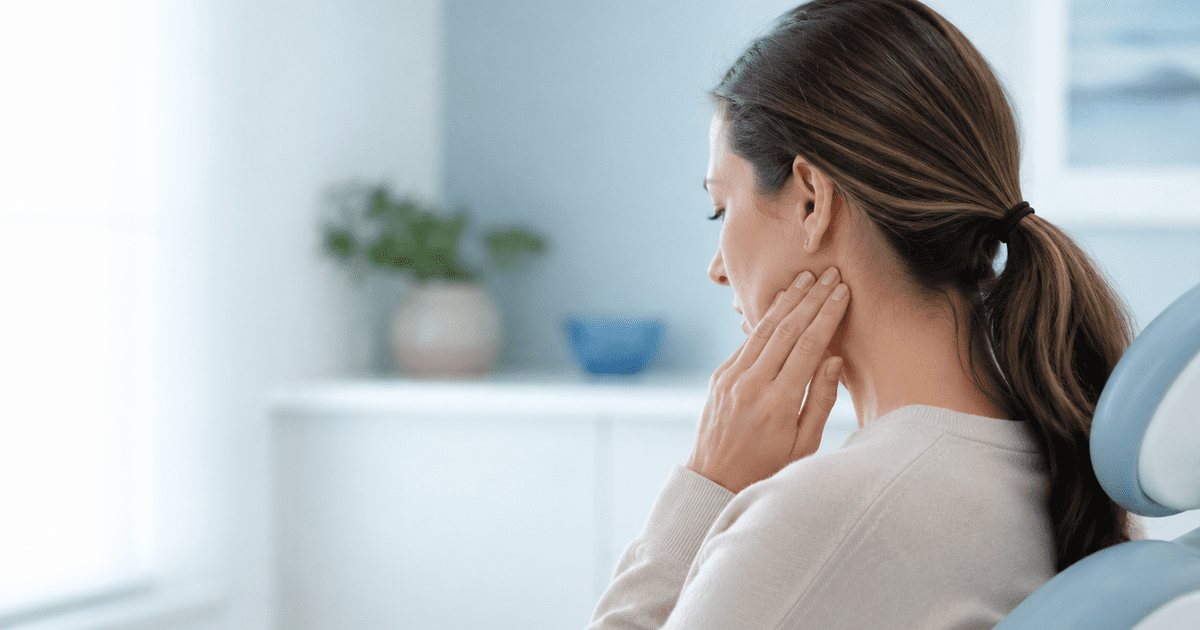
You’ve had headaches for years. You’ve tried everything — ibuprofen, prescription medications, chiropractic, massage, even Botox injections. Some things helped temporarily. Nothing fixed it.
What if the headaches were never the problem? What if they were a symptom of something upstream — something in your jaw, your joint, or your airway — that no one has ever examined?
This is one of the most common and most consequential misdiagnoses I encounter in clinical practice. Patients arrive having been treated for migraine, tension headache, cluster headache, or “stress headaches” for years — sometimes decades — when the actual driver of their pain was the temporomandibular joint and the muscles around it.
Getting this right matters. Not just because it explains the pain, but because treating a TMJ-driven headache the same way you’d treat a primary migraine produces incomplete results at best — and at worst, keeps patients on unnecessary medications indefinitely.
Why the Jaw Can Cause Headaches
The temporomandibular joint sits immediately in front of the ear, directly adjacent to some of the most pain-sensitive anatomy in the human head. The trigeminal nerve — the largest and most complex cranial nerve — innervates the entire face, jaw, temples, and much of the scalp. It also governs sensation in the teeth, gums, sinuses, and inner ear.
When the TMJ is inflamed, when the disc is displaced, or when the muscles of mastication are chronically overloaded, the trigeminal nerve system becomes sensitized. Pain signals that originate in the jaw don’t stay in the jaw — they travel along trigeminal pathways to the temples, the forehead, behind the eyes, and into the neck and scalp.
This is called referred pain — and it’s why a patient can have severe temple pain or forehead headaches with virtually no jaw pain at all. The jaw is the generator; the head is where the patient feels it.
Additionally, the masseter and temporalis muscles — the primary jaw-closing muscles — attach directly to the temporal bone and zygomatic arch. When these muscles are chronically hypertonic (too tight), they create mechanical tension that refers pain across the temple region in a pattern nearly identical to a tension-type headache.
Types of Headaches That Are Commonly TMJ-Driven
Tension-Type Headaches
Tension headaches are the most commonly diagnosed headache type — and they are also the type most frequently driven by TMJ dysfunction. The classic presentation is a band-like pressure or tightness across the forehead and temples, often bilateral, without nausea or light sensitivity.
What most patients are not told is that “tension” in this context does not mean emotional stress — it means muscular tension. And the muscles most responsible are frequently the masseter and temporalis, not the neck or scalp muscles that most people assume.
Patients with TMJ-driven tension headaches often notice that their headaches are worse in the morning (after a night of clenching), correlate with jaw stiffness, and are accompanied by temple or facial tenderness when pressed. These are not coincidences — they’re diagnostic clues.
Migraines
The relationship between TMD and migraine is more complex and remains an active area of research. What we know clinically is that TMJ dysfunction can both trigger migraines in susceptible patients and lower the threshold for migraine onset through trigeminal sensitization.
When the trigeminal nerve system is chronically activated by a dysfunctional TMJ, it becomes more reactive. Stimuli that wouldn’t normally trigger a migraine — bright light, certain foods, hormonal shifts — can tip the system into a full migraine episode because the baseline level of neural excitation is already elevated.
This explains why some migraine patients see meaningful reduction in frequency and severity when their TMJ dysfunction is properly treated, even when their migraine medications remain unchanged.
Cervicogenic Headaches
Cervicogenic headaches originate in the cervical spine and radiate into the head — typically starting at the base of the skull and moving forward. These headaches are consistently associated with TMJ dysfunction because forward head posture (a near-universal finding in TMD patients) places abnormal mechanical stress on the cervical vertebrae and the suboccipital musculature.
For every inch your head sits forward of your shoulders, approximately 10 additional pounds of effective weight are placed on your cervical spine. Over hours and years, this creates chronic muscular tension and joint loading in the upper cervical spine that generates headaches — while the same postural pattern simultaneously overloads the jaw.
Treating cervicogenic headaches without addressing the forward head posture and its relationship to jaw function is treating a consequence while ignoring a cause.
Cluster-Type Headaches
Cluster headaches — severe, unilateral, short-duration headaches often occurring at the same time of day or night — have a recognized association with sleep-disordered breathing. Patients who experience cluster headaches frequently have underlying OSA, and the headaches often coincide with sleep-related hypoxic events.
Given the strong connection between OSA and TMD, patients presenting with cluster-type headaches should always be evaluated for both sleep apnea and TMJ dysfunction as potential contributors.
How to Tell If Your Headache Is Coming From Your Jaw
No single test definitively identifies a headache as TMJ-driven — diagnosis requires clinical examination and, in most cases, imaging. But there are patterns that strongly suggest jaw involvement:
Timing and Pattern
- Headaches are worst in the morning — this correlates with nocturnal bruxism and joint loading during sleep
- Headaches occur or worsen after prolonged chewing, clenching, or jaw use
- Headaches accompany jaw stiffness, limited opening, or clicking
- Headaches are accompanied by ear symptoms — pain, fullness, ringing — which often reflect the same TMJ inflammation
Location
- Temple pain or pressure — masseter and temporalis referral pattern
- Pain behind the eyes — pterygoid and temporal muscle referral
- Base of skull pain — upper cervical and suboccipital referral associated with forward head posture
- Unilateral jaw/face/temple pain that doesn’t respond to migraine medications
Physical Findings
- Tenderness on palpation of the masseter, temporalis, or TMJ itself
- Clicking, popping, or crepitus in one or both joints
- Limited or asymmetric jaw opening
- Jaw deviation on opening (swings to one side)
- Worn, flattened, or chipped teeth — indicating bruxism
- Scalloped tongue edges or cheek ridging — indicating tongue pressure against teeth during sleep
The Diagnostic Problem: Why This Gets Missed
The headache medicine and neurology fields have classification systems for headache — most notably the International Classification of Headache Disorders (ICHD). These systems are excellent at categorizing primary headache disorders. They are less equipped to identify headaches that originate from secondary causes like TMJ dysfunction.
The result is a diagnostic gap: a patient presents with headaches, gets classified as “tension-type” or “migraine,” receives medication management — and the underlying structural driver in the jaw is never evaluated. The medications may provide partial relief (because they work downstream of the cause), which reinforces the diagnosis without ever addressing the source.
This is not a failure of the headache specialist — it’s a failure of the referral pathway. Neurologists are not trained to evaluate TMJ dysfunction. Dentists who do evaluate TMJ are often not connected to headache specialists. The patient falls into the gap between two specialties, neither of which has the full picture.
A TMJ and craniofacial pain specialist occupies exactly this gap — trained in both the dental and medical dimensions of craniofacial pain, able to evaluate the jaw, the airway, and the relationship between them.
What a TMJ-Focused Headache Evaluation Includes
When a patient comes to Restorative Wellness Center with a chief complaint of chronic headaches — even if they’ve never been told they have a “TMJ problem” — the evaluation goes considerably deeper than a standard headache workup:
- CBCT imaging: Evaluates condylar morphology, joint space, and any degenerative changes that correlate with pain generation
- Joint Vibration Analysis: Identifies disc displacement and characterizes joint dysfunction without MRI cost or wait time
- Palpation of masticatory and cervical musculature: Identifies trigger points and referral patterns that reproduce the patient’s headache
- Range of motion and jaw tracking: Deviation patterns indicate disc and muscle dysfunction
- Postural assessment: Forward head posture measurement and cervical curve evaluation
- Sleep-disordered breathing screen: Given the OSA-TMD-headache connection, airway evaluation is standard for all headache patients
The goal is to determine whether the headache has a structural, mechanical, or airway-related driver — and if so, to treat that driver directly rather than managing the headache symptom in isolation.
Treatment: What Changes When the Jaw Is the Source
When headaches are identified as TMJ-driven, the treatment approach shifts fundamentally. Instead of medications that target the headache, we target the jaw:
- Orthotic stabilization: A custom orthotic repositions the jaw into its orthopedic rest position, removes destructive loading from the joint, and interrupts the clenching cycle that drives both joint pain and referred headache
- Regenerative injection therapy (PRF/PRP): For patients with structural joint involvement, platelet-rich fibrin injections deliver concentrated growth factors to the avascular joint space, reducing inflammation and stimulating tissue repair
- Photobiomodulation: Near-infrared light therapy reduces neurogenic inflammation and supports nerve healing — directly relevant for trigeminal sensitization that drives referred headache
- Trigger point therapy: Direct treatment of hypertonic masseter and temporalis trigger points that are generating the referred pain pattern
- Airway management: For patients with concurrent sleep-disordered breathing, treating the airway removes the primary driver of nocturnal bruxism — which removes the primary driver of morning headaches
Most patients with TMJ-driven headaches begin to see improvement within 2–4 weeks of beginning orthotic therapy. The improvement is not subtle — patients who have had daily headaches for years often report their first headache-free weeks in recent memory.
A Note on Medications
This article is not an argument against headache medications — they have an important role in managing acute pain and in patients with genuine primary headache disorders. But for patients whose headaches are driven by TMJ dysfunction, medications address the consequence rather than the cause.
Long-term reliance on pain medications for TMJ-driven headaches carries its own risks: rebound headaches from analgesic overuse, side effect burden, and the ongoing cost of treating a symptom that has a treatable source.
The most important question to ask — and the one that is too rarely asked — is: Why do I have these headaches? What is generating them? For a significant percentage of chronic headache patients, the answer is in the jaw.
When to Seek Evaluation
Consider a TMJ and craniofacial pain evaluation for your headaches if:
- Headaches are worst in the morning or upon waking
- You have jaw pain, stiffness, clicking, or limited opening along with headaches
- Headaches are located in the temples, behind the eyes, or at the base of the skull
- You grind or clench your teeth (or have been told you do)
- Headaches have not responded adequately to standard migraine or tension headache treatments
- You have ear symptoms (pain, fullness, ringing) alongside headaches
- You suspect a sleep problem may be connected to your headaches
The jaw is not the source of every headache. But it is the source of far more headaches than the medical system currently recognizes — and for those patients, the path to relief runs through proper TMJ evaluation and treatment, not through a lifetime of headache medications.
About the Author
Dr. Kyle Benton, DDS, FAACP is a TMJ and craniofacial pain specialist at Restorative Wellness Center in Rogers, Arkansas. He specializes in diagnosing and treating the jaw-headache-airway connection that most providers miss. Schedule a consultation or call (479) 265-1400.
Related: TMJ Treatment at Restorative Wellness Center | Craniofacial Pain & Headaches | SPG Block Therapy