
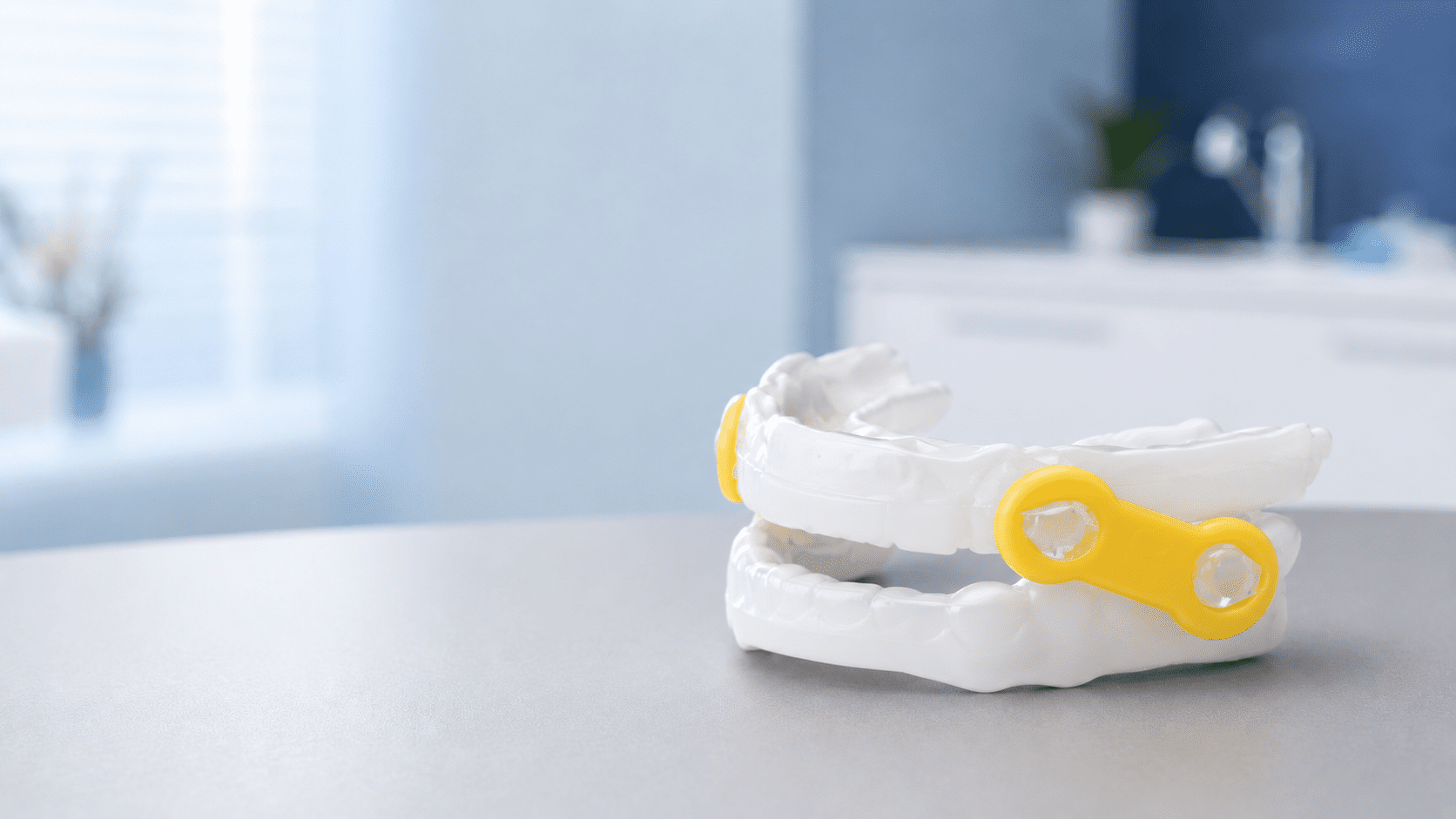
Quick Answer: Top 7 Oral Appliance Therapy Options for Sleep Apnea
- DDSO (Digital Sleep Orthotic), custom-fabricated, phonetic bite protocol, best for patients with concurrent TMJ involvement; no morning repositioner needed
- Herbst Appliance, Medicare-covered, bilateral rod-and-tube mechanism, limited lateral movement; appropriate for Medicare patients requiring insurance documentation
- Shirazi Hybrid (OAT + CPAP combined), for severe OSA (AHI >30), obesity, or anatomically complex airways where OAT alone is insufficient
- TAP (Thornton Adjustable Positioner), titratable single-point hook mechanism; strong clinical evidence base; easy patient adjustment
- Narval CC (ResMed), CAD/CAM fabricated, low-profile, high patient compliance; good for mild-to-moderate OSA
- EMA (Elastic Mandibular Advancement), elastic straps allow lateral movement; good for bruxers; not ideal for severe OSA
- SomnoDent (SomnoMed), dual-block design, independent jaw movement, strong compliance data; widely available
Cost range in NW Arkansas: $1,800-$4,500 before insurance coverage, depending on appliance type and OSA severity. Restorative Wellness Center courtesy files insurance on the patient’s behalf. Learn more about what oral appliance therapy costs and how insurance applies.
Why Oral Appliance Selection Matters
Not all oral appliances are the same, and the wrong appliance for a given patient creates new problems while failing to solve the original one. The most common mistake in dental sleep medicine is treating OSA in isolation from TMJ. Patients with both conditions (and most moderate-to-severe OSA patients have subclinical TMD) require an appliance designed for both the airway and the joint simultaneously.
This guide explains each option, who it is appropriate for, and what the clinical evidence shows, so patients and referring physicians can make an informed choice.
1. DDSO (Digital Sleep Orthotic), Dr. Benton’s Primary Protocol
Best for: Patients with OSA + TMJ symptoms, bruxism, morning jaw pain, or any disc displacement findings
The DDSO is a precision-fabricated oral appliance designed using a phonetic bite record, a technique developed within the Olmos SSC (Spencer Study Club) protocol. Unlike standard mandibular advancement devices that advance the jaw to a set measurement (usually 60-75% of maximum protrusion), the phonetic bite uses natural speech phonemes to identify the jaw’s physiologically optimal resting position.
Why this matters clinically:
- Standard advancement devices over-advance the jaw in approximately 40% of cases, creating or worsening TMJ strain
- The phonetic bite achieves airway patency with 15-30% less mandibular advancement than traditional titration, reducing TMJ load while maintaining OSA efficacy
- No morning repositioner is needed (morning repositioners address soreness caused by over-advancement, which the phonetic bite avoids by design)
DDSO + concurrent TMJ treatment: When OSA and TMD co-exist, treating them separately produces incomplete outcomes. The DDSO is designed to simultaneously decompress the TMJ and maintain airway patency, treating the Pain-Sleep-Breathing triad as a unified system.
2. Herbst Appliance, Medicare-Covered Option
Best for: Medicare patients requiring insurance documentation; moderate OSA without significant TMJ involvement
The Herbst is a bilateral rod-and-tube mechanism that connects upper and lower trays, preventing the mandible from falling back during sleep. It is one of the most widely covered oral appliances under Medicare (HCPCS code E0486) and is accepted by most commercial insurers.
Limitations:
- Bulky design, larger vertical dimension than more modern appliances
- No independent lateral jaw movement, patients cannot move the jaw side-to-side while wearing it
- Reduced tongue space compared to single-arch or low-profile designs
The Herbst remains the standard for Medicare documentation because of its long evidence history, not because it outperforms newer designs clinically. For patients without insurance requirements, more refined options typically achieve better outcomes with greater comfort.
3. Shirazi Hybrid, Combination OAT + CPAP
Best for: Severe OSA (AHI >30), obesity (BMI >35), complex anatomy, or CPAP-partial responders
The Shirazi Hybrid integrates oral appliance advancement with a low-pressure CPAP interface. This combination approach is appropriate when OAT alone cannot achieve sufficient AHI reduction, typically in patients with:
- AHI above 30 on diagnostic study
- Retrognathic mandible with limited advancement range
- Significant obesity contributing pharyngeal fat deposition
- CPAP users who tolerate moderate but not full pressure
Combination therapy achieves AHI reduction equivalent to full CPAP in a subset of severe OSA patients, with substantially better long-term adherence compared to CPAP alone.
4. TAP (Thornton Adjustable Positioner)
Best for: Patients who want direct control over titration; mild-to-moderate OSA; patients who travel frequently
The TAP series uses a single central hook mechanism connecting upper and lower trays. The patient can advance the mandible in precise 0.25 mm increments by turning an adjusting key, without a clinic visit.
The TAP has one of the strongest published evidence bases among mandibular advancement devices, with multiple randomized controlled trials demonstrating significant AHI reduction in mild-to-moderate OSA. A 2019 meta-analysis of 67 RCTs found MADs including the TAP reduced AHI by an average of 13.6 events/hour compared to placebo.
5. Narval CC (ResMed)
Best for: Mild-to-moderate OSA; patients prioritizing comfort and compliance; patients who find bulkier devices intolerable
The Narval CC is fabricated using CAD/CAM milling from digital scans, eliminating the variability of traditional impression-based fabrication. Its design is thin, low-profile, and allows significant lateral and vertical jaw movement during sleep.
ResMed’s published data shows 87% of Narval CC users report comfortable sleep at 12 months, among the highest reported compliance figures for any OAT device. For patients who have abandoned previous oral appliances due to discomfort, the Narval CC is often the appropriate next step.
6. EMA (Elastic Mandibular Advancement)
Best for: Bruxers; patients with morning joint soreness from rigid appliances; mild snoring/mild OSA
The EMA uses interchangeable elastic straps rather than rigid connectors between upper and lower trays. This allows full range of lateral jaw movement during sleep, which may reduce joint loading in bruxism patients.
Limitations: Elastic straps have a finite lifespan and require periodic replacement. For moderate-to-severe OSA, the EMA’s advancement range is typically insufficient.
7. SomnoDent (SomnoMed)
Best for: Mild-to-moderate OSA; patients who want lateral jaw freedom with a rigid-connector option
The SomnoDent uses a dual-block design with independent upper and lower trays connected by a precision coupling mechanism. This allows lateral movement during sleep while maintaining controlled mandibular advancement.
A 2013 RCT demonstrated significant AHI reduction and improved quality of life scores at 1 year. Long-term compliance (>4 hrs/night) was reported at 62% at 3 years, comparable to CPAP adherence data from the same period.
How to Choose the Right Oral Appliance
The right appliance depends on:
| Factor | Recommended Option |
|---|---|
| OSA + TMJ symptoms | DDSO (phonetic bite protocol) |
| Severe OSA (AHI >30) or obesity | Shirazi Hybrid |
| Medicare coverage required | Herbst |
| Patient self-titration preference | TAP |
| Maximum comfort/compliance priority | Narval CC |
| Active bruxism with lateral grinding | EMA |
| Widely available, independently studied | SomnoDent |
At Restorative Wellness Center in Rogers, AR, appliance selection is based on a full diagnostic workup: CBCT imaging, pharyngometry (airway dimension measurement), joint evaluation, and medical history. A phonetic bite record is taken for all patients where TMJ findings are present. The goal is to treat the sleep apnea treatment and the joint simultaneously, not sequentially.
You can compare all of our options on our treatments page.
Frequently Asked Questions
Does insurance cover oral appliance therapy for sleep apnea in Arkansas?
Many commercial insurers and Medicare cover OAT for diagnosed OSA. Coverage requires a physician-ordered sleep study (HSAT or PSG) with an OSA diagnosis (AHI 5 or above with symptoms, or AHI 15 or above). Restorative Wellness Center courtesy files on the patient’s behalf. Cost range before insurance: $1,800-$4,500.
How effective is oral appliance therapy compared to CPAP?
For mild-to-moderate OSA, OAT achieves comparable AHI reduction to CPAP in most patients, with significantly better long-term adherence (OAT: approximately 65-75% using device more than 4 hrs/night at 1 year vs. CPAP: approximately 40-50%). For severe OSA, combination therapy (Shirazi Hybrid) is often needed.
Can oral appliance therapy make TMJ worse?
It can, if the wrong appliance is used or if the mandible is over-advanced. Standard advancement to 60-75% of maximum protrusion frequently loads the TMJ in patients with existing disc displacement. The phonetic bite protocol used at Restorative Wellness Center avoids this by using a physiologically guided bite position rather than a percentage-of-maximum measurement.
Do I need a sleep study before getting an oral appliance?
Yes, for insurance coverage and for appropriate appliance selection, a sleep study with an OSA diagnosis from a physician is required. Restorative Wellness Center can refer for HSAT (home sleep apnea test) or coordinate with your sleep physician.
What happens if oral appliance therapy doesn’t work?
Incomplete responders have several options: appliance retitration, combination therapy with low-pressure CPAP (Shirazi Hybrid), weight management, positional therapy, or surgical evaluation. No single treatment works for every patient, the goal is the most effective, most adherence-compatible solution for your specific anatomy and severity. If you’ve tried CPAP alternatives without success, a comprehensive evaluation at Restorative Wellness Center can help identify the right path forward. Learn more about our comprehensive sleep apnea treatment in Northwest Arkansas.
Related reading: Explore all TMJ, sleep apnea, and craniofacial pain treatments at Restorative Wellness Center, or learn more about oral appliance therapy in Northwest Arkansas.
Not sure which appliance style fits your specific case? See a full breakdown of oral appliance therapy for sleep apnea in Rogers, AR.
If jaw pain or TMJ symptoms are part of what you’re dealing with alongside sleep apnea, learn more about TMJ treatment in Rogers, AR.