Yes. And it is more common than most patients — and many clinicians — realize.
Dizziness and vertigo are among the most frustrating symptoms to chase. Neurology clears you. Cardiology clears you. Your ENT finds no BPPV, no Meniere’s disease, no vestibular neuritis. The MRI is normal. And yet the room still spins when you lie down, or you feel unsteady throughout the day in a way that is hard to describe to anyone who hasn’t experienced it.
When conventional workup comes back negative, the jaw is one of the most commonly overlooked sources — particularly in patients who also experience jaw pain, clicking, ear fullness, or morning headaches.
At Restorative Wellness Center in Rogers, Arkansas, dizziness and balance complaints come up regularly in TMJ patient intake. Understanding the mechanism is the first step to understanding why treatment of the jaw can resolve symptoms that seem to have nothing to do with it.
The Anatomy That Connects the Jaw to Balance
The connection between the temporomandibular joint and the vestibular system — the inner ear structures responsible for balance — runs through several overlapping anatomical pathways.
Proximity. The TMJ sits directly anterior to the inner ear, separated by the tympanic plate of the temporal bone. In some individuals, the joint capsule is separated from the inner ear by millimeters. Inflammation, disc displacement, or significant condylar displacement in the joint can produce pressure effects on adjacent inner ear structures.
The auriculotemporal nerve. This branch of the trigeminal nerve passes directly along the TMJ capsule before entering the ear canal. When the joint is inflamed or the condyle is displaced posteriorly, this nerve is frequently irritated or compressed. The auriculotemporal nerve has connections to the middle ear and to the retrodiscal tissue, and its irritation can produce a cascade of inner ear symptoms — including pressure, fullness, tinnitus, and altered vestibular signaling.
The tensor veli palatini and tensor tympani. Both of these muscles are innervated by the trigeminal nerve. The tensor tympani regulates tension of the tympanic membrane. The tensor veli palatini controls the eustachian tube. When the trigeminal system is under chronic mechanical load from jaw dysfunction, both muscles can be affected — altering middle ear pressure dynamics and eustachian tube patency in ways that secondarily affect vestibular function.
Cervical proprioception. The muscles of the jaw and the muscles of the upper cervical spine share neural territory. The masseter, temporalis, and pterygoid muscles have reflex connections to the sternocleidomastoid and upper trapezius. Chronic jaw muscle hypertonicity — common in bruxism and TMJ dysfunction — produces corresponding upper cervical tension. The cervical spine contributes significantly to proprioceptive input for balance. When cervical proprioception is disrupted by muscle tension, dizziness and postural instability are predictable consequences.
The trigeminal-vestibular connection. Research has documented direct neurological connections between the trigeminal nucleus and the vestibular nuclei in the brainstem. These nuclei share the same brainstem territory. Chronic nociceptive input from the jaw — through V3 — can sensitize the trigeminal nucleus and produce secondary effects on vestibular processing. This is one proposed mechanism for why some patients experience spatial disorientation or motion sensitivity as a feature of craniofacial pain rather than a primary vestibular disorder.
Types of Dizziness Associated With TMJ
Patients with jaw-related vestibular symptoms describe their dizziness in several ways. Understanding the pattern helps distinguish TMJ-related dizziness from primary vestibular pathology.
Postural unsteadiness. Many TMJ patients describe a persistent sense of being “off” or unsteady — not vertigo in the classic sense, but a feeling that they have to think more carefully about where they are in space. This is often worse with fatigue or after prolonged jaw use, and frequently correlates with days when jaw pain or muscle tension is higher.
Positional dizziness that doesn’t fit BPPV. BPPV (benign paroxysmal positional vertigo) produces brief, predictable vertigo with specific head movements, classically to one side when lying down. TMJ-related positional dizziness is less predictable — it may occur when turning the head, opening the mouth wide, yawning, or in positions that load one side of the jaw. The Dix-Hallpike test is often negative or equivocal.
Dizziness correlated with jaw symptoms. When dizziness fluctuates with jaw pain — better on low-pain days, worse when jaw tension is high — a jaw driver is strongly suggested. Similarly, dizziness that is consistently worse in the morning (correlating with overnight bruxism) and improves through the day is a pattern more consistent with jaw-related etiology than primary vestibular disease.
Motion sensitivity without true vertigo. Some patients do not experience spinning but describe pronounced sensitivity to motion, visual complexity, or environments with lots of movement around them. This can be a feature of central sensitization involving the trigeminal-vestibular pathway.
Why This Gets Missed
The diagnostic gap here follows the same pattern as TMJ and ear symptoms: the jaw falls between medicine and dentistry, and neither specialty routinely screens for the other’s domain.
When a patient presents to neurology or ENT with dizziness, the evaluation appropriately focuses on central causes (stroke, tumor, vestibular migraine), peripheral causes (BPPV, Meniere’s, labyrinthitis), and cardiovascular causes (orthostatic hypotension, arrhythmia). The jaw is not on this differential. If it is not specifically asked about, the connection is never made.
A second factor: patients do not volunteer jaw symptoms when they are presenting for dizziness, because they do not associate the two. Unless a clinician specifically asks about jaw pain, clicking, morning headaches, and ear fullness alongside the dizziness complaint, the cluster of symptoms that points to TMJ goes unrecognized.
What Evaluation Looks Like
When dizziness is part of a patient’s presentation alongside other jaw or craniofacial symptoms, the evaluation at Restorative Wellness Center includes:
Joint loading assessment. Applying directed pressure to the TMJ capsule and observing whether this reproduces or alters vestibular symptoms. A positive response — dizziness or ear fullness that changes with joint loading — is significant.
Muscle palpation. The masseter, temporalis, and medial pterygoid muscles are palpated for tenderness and hypertonicity. In patients with jaw-related dizziness, the ipsilateral (same side) muscles are typically significantly more tender than the contralateral side, correlating with the side of reported symptoms.
Cervical assessment. The upper cervical musculature — particularly the suboccipital muscles and sternocleidomastoid — is evaluated for tension that may be contributing to proprioceptive disruption and secondary dizziness.
Phonetic bite analysis. Jaw position during natural speech reveals condylar position during function. Posterior condylar displacement — where the condyle is compressed toward the inner ear — is one of the structural findings most associated with ear and vestibular symptoms.
Sleep screening. Nocturnal bruxism and sleep-disordered breathing load the jaw for hours overnight. If dizziness is consistently worse in the morning, identifying and treating the overnight driver often produces the most dramatic improvement.
Treatment and Outcomes
When jaw dysfunction is identified as a primary or contributing driver of dizziness, treatment follows the same pathway as TMJ treatment generally — but the expected timeline for vestibular symptom improvement may be longer than for pain, because the vestibular system requires recalibration as the underlying mechanical input changes.
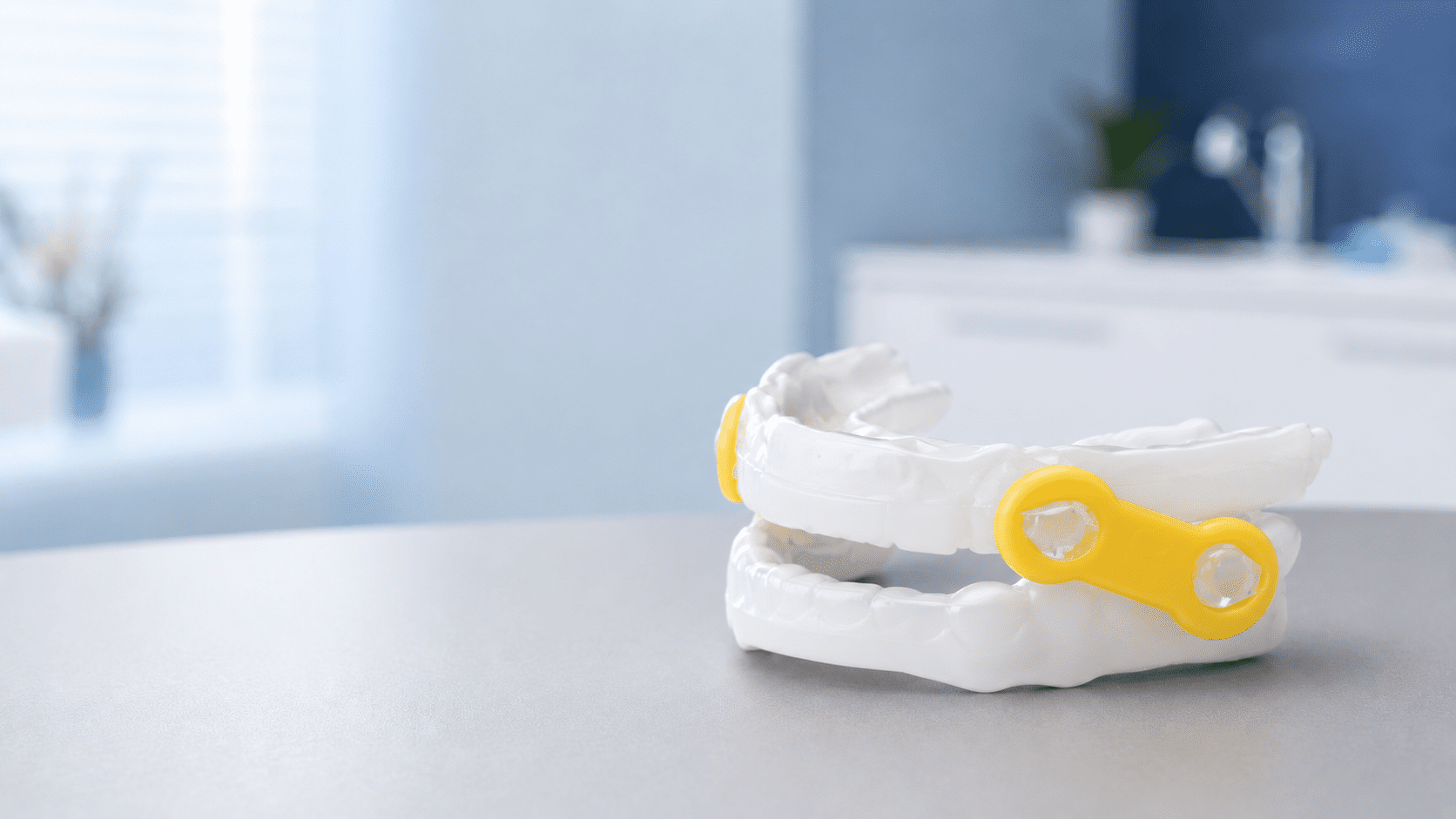
Orthotic therapy. A properly positioned orthotic decompresses the condyle, reduces auriculotemporal nerve irritation, and shifts jaw muscle activity in ways that reduce cervical tension. Vestibular symptoms often begin improving within four to eight weeks of consistent orthotic use. Learn more about our treatment options for TMJ-related dizziness.
Oral appliance therapy for sleep-disordered breathing. Patients whose dizziness is driven primarily by overnight jaw loading often see significant improvement once the sleep component is addressed. Reducing the bruxism reflex that accompanies airway events reduces the nighttime joint loading that produces morning dizziness.
Jaw physical therapy. Targeted exercises and manual therapy for the jaw and upper cervical muscles — often provided by a physical therapist trained in craniofacial conditions — address the muscular component and cervical proprioceptive disruption that contributes to balance dysfunction.
The most important message for patients: unexplained dizziness that has already been cleared by neurology and ENT is not a dead end. A structured craniofacial pain evaluation is a reasonable and often high-yield next step when jaw and ear symptoms are part of the picture.
Frequently Asked Questions
Can a night guard help with dizziness caused by TMJ?
A night guard that reduces grinding and clenching can reduce the overnight joint loading that contributes to vestibular symptoms. However, a poorly fitted night guard that positions the condyle incorrectly can make symptoms worse. An orthotic fitted by a craniofacial pain specialist — using phonetic bite analysis or equivalent evaluation — is more likely to produce improvement than an over-the-counter or generically fitted device.
How long does it take for TMJ treatment to help dizziness?
Pain often improves within two to four weeks of orthotic use. Vestibular symptoms can take longer — typically four to twelve weeks — because the vestibular system adapts gradually as the mechanical input changes. Patients who also address the sleep-disordered breathing component often see faster improvement.
Is TMJ-related dizziness the same as Meniere’s disease?
No. Meniere’s disease involves endolymphatic hydrops — fluid pressure dysregulation in the inner ear — and has distinct diagnostic criteria including low-frequency hearing loss and episodic vertigo. TMJ-related dizziness operates through different mechanisms (nerve compression, muscular tension, cervical proprioception) and does not involve the same inner ear fluid changes. However, some patients with Meniere’s also have TMJ dysfunction, and treating the jaw component can reduce the frequency and severity of episodes in that subset.
Should I see a neurologist or a TMJ specialist first?
If you have not had a neurological evaluation, start there to rule out central causes. Once cleared, a structured craniofacial pain evaluation is an appropriate next step — particularly if you also have jaw pain, clicking, ear fullness, or morning headaches alongside the dizziness. Patients who also experience jaw-driven headaches alongside dizziness often benefit most from a comprehensive craniofacial evaluation.
Kyle Benton, DDS, FAACP is the founder of Restorative Wellness Center in Rogers, Arkansas, where he specializes in temporomandibular disorders, craniofacial pain, and sleep-disordered breathing. He completed advanced training in occlusion and craniofacial pain through the American Academy of Craniofacial Pain.