
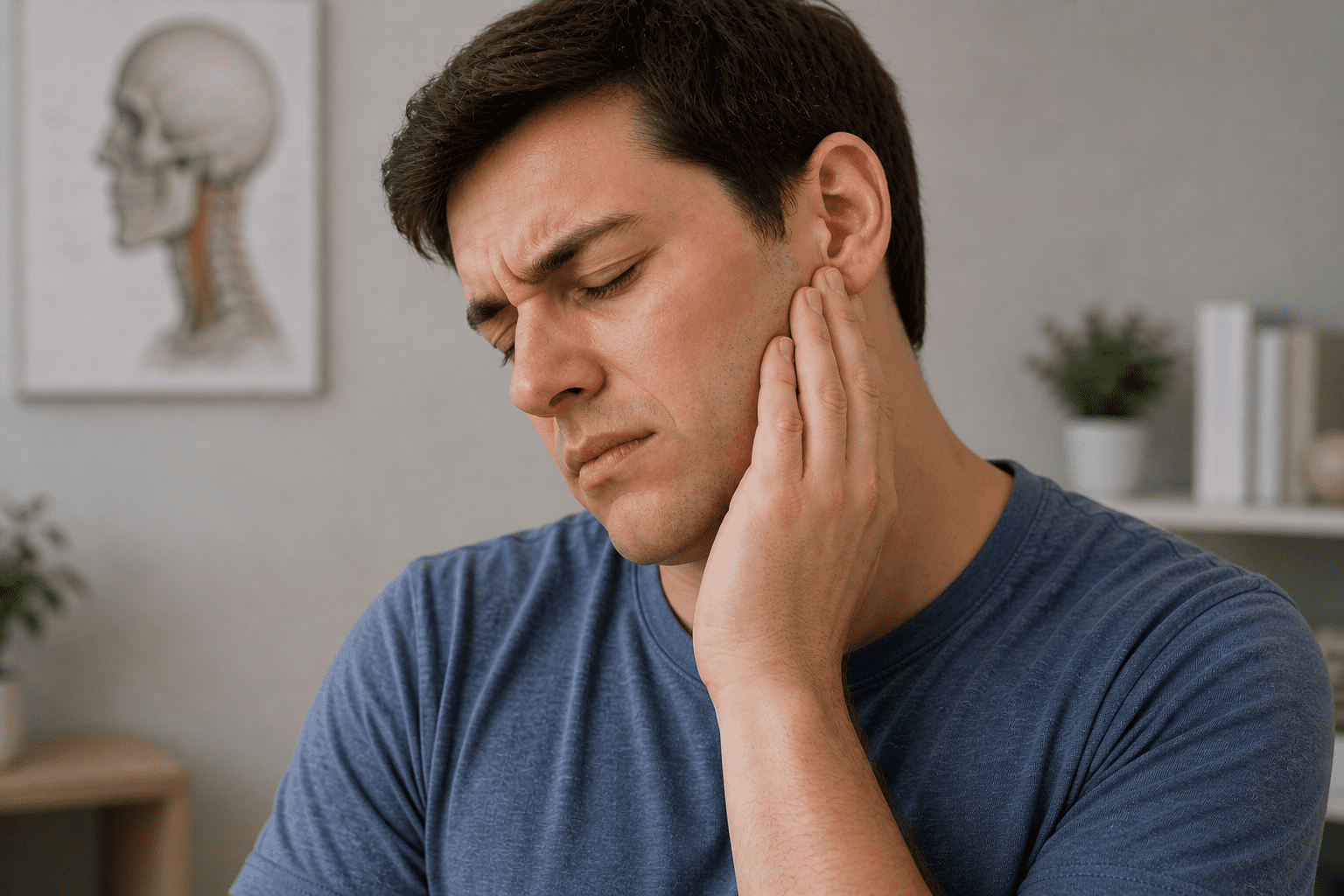
TMJ neck pain headaches Rogers AR patients experience together represent one of the most common and most mismanaged pain patterns in adults, and their co-occurrence is not a coincidence. There is a well-established anatomical and neurological basis for the relationship between these three regions, and understanding it is essential to treating any of them effectively. The connection between tmj neck pain headaches Rogers AR patients is one of the most consistent clinical patterns seen at Restorative Wellness Center, and it is one of the most commonly missed by providers who evaluate each complaint in isolation.
Quick Answer: Jaw tension does not remain isolated to the jaw joint but transmits through muscular and neurological pathways to the neck and base of the skull, creating a system where jaw dysfunction, neck pain, and headaches are interconnected rather than separate problems. The trigeminal nerve serves the jaw and face, and its descending nucleus extends into the upper cervical spinal cord, creating neurological overlap where signals from the jaw and signals from the upper cervical spine converge in the same region of the nervous system. When chronic jaw tension develops from clenching or grinding, this muscular tension transmits to the muscles at the base of the skull, contributing to neck stiffness and headaches alongside jaw symptoms. Single region treatments often plateau with these patients because the system is interconnected, treating the neck alone can leave the primary driver in the jaw unaddressed, just as treating the jaw alone can leave cervical muscle patterns unresolved. Evaluation addressing jaw, airway, cervical spine, and postural factors together tends to produce better outcomes than fragmented care addressing isolated components.
Table of Contents
TMJ Neck Pain Headaches Rogers AR: The Muscular Pathway
The muscles that move and stabilize the jaw do not operate in isolation. The masseter, temporalis, medial and lateral pterygoids, and the suprahyoid and infrahyoid muscle groups all attach to structures that connect directly or indirectly to the skull and cervical spine. When the jaw is chronically loaded, from bruxism and nighttime clenching, grinding, or an unstable resting position, the tension generated in these muscles does not stay in the face. It transmits to the suboccipital muscles at the base of the skull and into the upper cervical musculature, producing the neck stiffness and upper trapezius tension that TMD patients frequently report alongside their jaw symptoms.
Trigeminal-Cervical Convergence: Why Pain Crosses Regions
The neurological basis for tmj neck pain headaches Rogers AR presentations is equally significant. The trigeminal nerve is the primary sensory nerve of the face, jaw, and anterior scalp, and its descending nucleus extends into the upper cervical spinal cord where it interfaces with the cervical dorsal horn. This means that nociceptive signals from the jaw and signals from the upper cervical structures converge in the same region of the central nervous system. The brain can misattribute pain from one region to the other, producing jaw pain that feels like a neck problem, or a headache that originates in the jaw but is perceived at the temple or the back of the head.
Why Partial Treatment Produces Partial Results
This convergence explains why many TMD patients report that their headaches feel like tension headaches or cervicogenic headaches, and why patients who receive only cervical treatment for their headaches improve partially but not completely. The cervical component is real, but it is often a downstream consequence of jaw-driven tension rather than a primary pathology. This is the central clinical lesson in tmj neck pain headaches Rogers AR cases, treating the neck without addressing the jaw removes one contributing input but leaves the primary driver in place. The same logic applies in reverse, treating the jaw without addressing the cervical component leaves a secondary perpetuating factor unresolved.
The PT-Dental Disconnect and the Plateau Problem
Physical therapists who treat the cervical spine without evaluating the jaw frequently observe that their patients plateau at a certain level of improvement and cannot progress further. Dental providers who treat the jaw without considering cervical involvement often see similar incomplete results. The reason is the same in both cases: the pain system is interconnected, and partial treatment of an interconnected system produces partial results.
A Pattern Most Multi-Provider Patients Recognize
TMJ neck pain headaches Rogers AR patients who have seen multiple providers without lasting relief often share this history: cervical manipulation that helps for a few days, a nightguard that protects the teeth but does not change the headache pattern, and trigger point injections that require repeat visits to maintain any benefit. Each provider treated their piece correctly. The failure was not in the individual treatments. It was in the absence of a coordinated evaluation that identified the jaw, the airway, and the cervical spine as a single functional unit.
At Restorative Wellness Center in Rogers, Arkansas, jaw pain, neck tension, and headaches are evaluated as parts of a connected system. Our intake process includes assessment of jaw position, joint health via TMJ evaluation and cone beam CT imaging, muscle function, and cervical involvement so that the full picture of the patient’s pain pattern is understood before treatment begins. If tmj neck pain headaches Rogers AR is a pattern you recognize in your own symptoms, a comprehensive evaluation that addresses all three components is the appropriate starting point.
Frequently Asked Questions
Why do patients see improvement from physical therapy but symptoms return?
Physical therapy may temporarily reduce neck muscle tension and improve cervical mobility, but if the underlying jaw dysfunction driving the neck tension remains untreated, symptoms can return when therapy ends. The jaw represents the primary driver of dysfunction in many patients whose neck pain and headaches stem from compensatory muscle tension secondary to temporomandibular joint problems. Addressing only the neck while leaving the jaw problem unresolved leaves the root cause in place, which can limit how much improvement lasts. Evaluation should identify whether the jaw dysfunction is primary, whether the cervical spine is primary, or whether both systems require treatment together. When physical therapists and dental specialists collaborate on assessment, they can often identify the true primary driver and design integrated treatment aimed at more lasting resolution.
Can addressing just my jaw fix my headaches if I also have neck pain?
If headaches and neck pain originate from jaw dysfunction, then addressing the jaw dysfunction through appliance therapy, myofunctional therapy, and stress management may resolve both the jaw symptoms and the secondary neck pain and headaches. However, if primary cervical spine dysfunction, independent pathology, or postural problems are also contributing, jaw treatment alone will likely produce incomplete results. Evaluation that addresses jaw, airway, cervical spine alignment, and overall posture helps identify all contributing factors. Treatment plans often need to address multiple body regions together rather than treating one region in isolation. A specialist will determine whether jaw treatment alone addresses the complete clinical picture or whether integrated treatment incorporating cervical evaluation and postural support produces better outcomes for a specific symptom pattern.